Talent Scout
An AI agent that works as your recruiting assistant, turning complex hiring tasks into a simple, conversational experience.
The problem
Recruiters are drowning in noise. Hiring scales and systems don’t. Recruiters juggle disparate tools, ambiguous matches, and job posts that underperform — all while missing out on talent that’s right in front of them.
Opportunity
What if AI could eliminate the manual work that bogs down recruiting, surface candidates traditional search would miss, and help employers define what 'good fit' actually means? That opportunity elevated this from a backlog item to a CEO-led initiative — with potential to reshape Indeed's core recruiting business.

Talent Scout's key focus areas
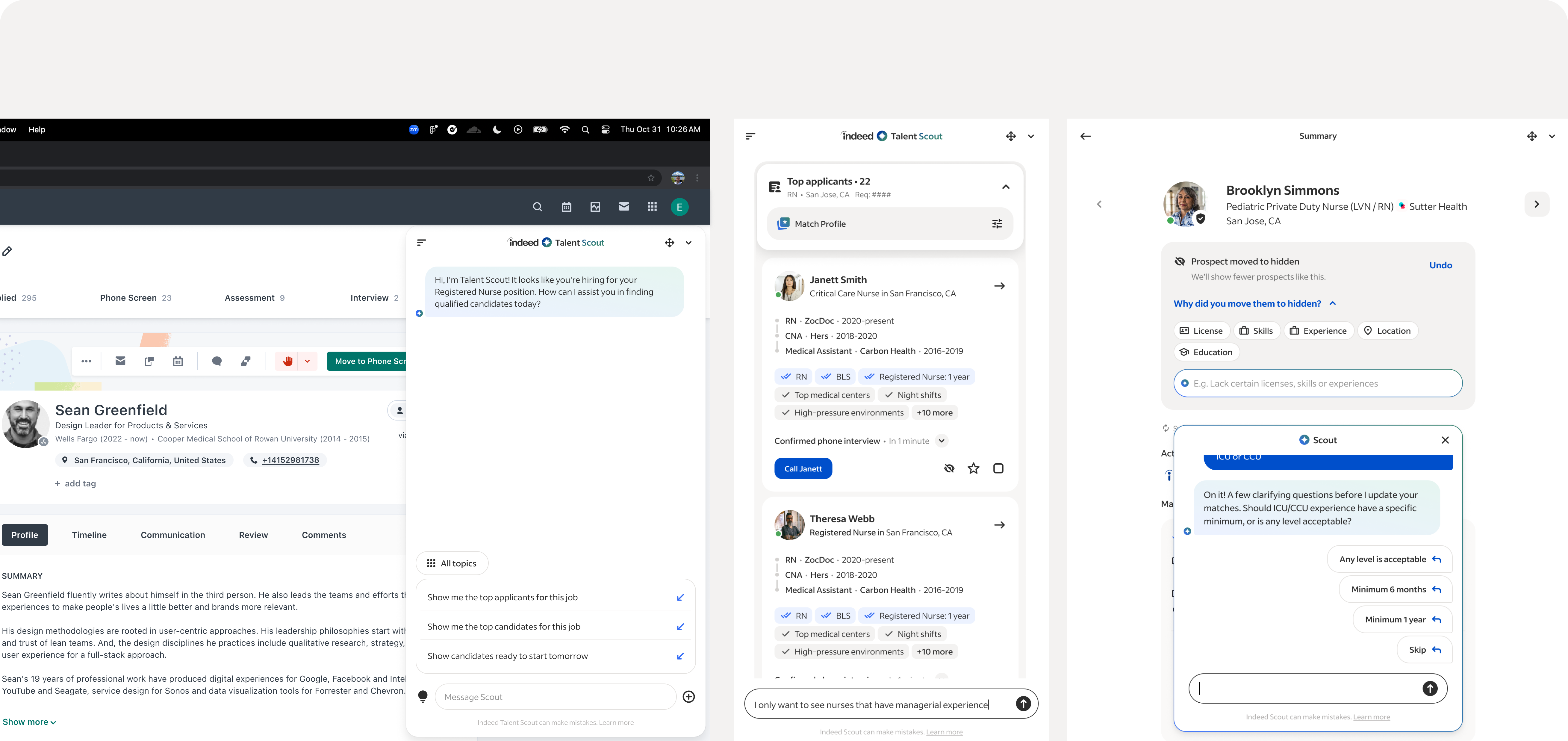
Chat interface embedded directly in Indeed and partner ATS tools
Smart, contextual tips that help employers improve job performance and messaging on the fly
Connect employers with candidates through AI-powered matching
Early design days
Our first challenge was designing a unified interaction framework flexible enough to work across Talent Scout and multiple ATS products without losing depth or speed.
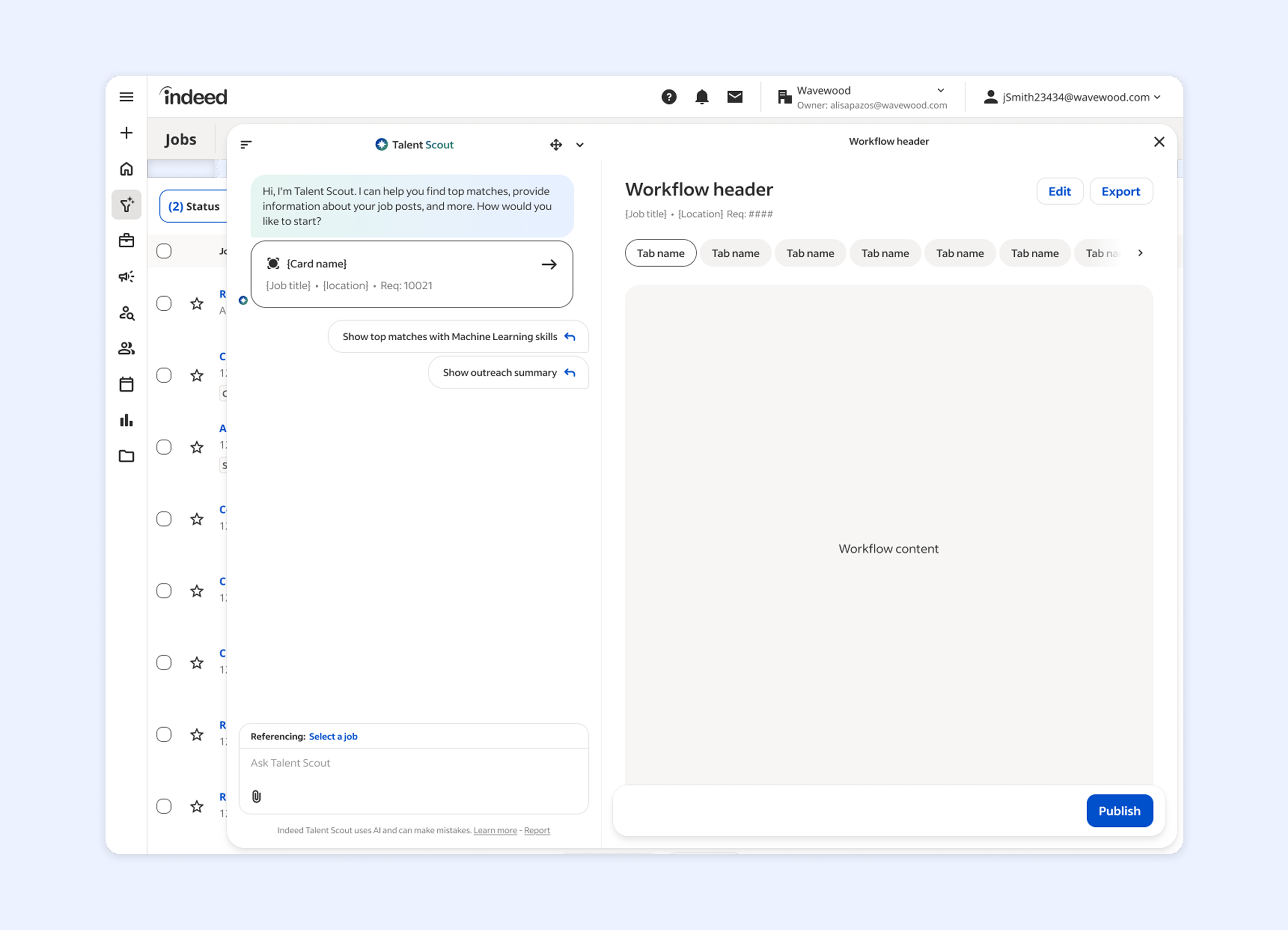
Workflow panels
We created a flexible system where chat cards serve as entry points, expanding into complex workflows only when needed.
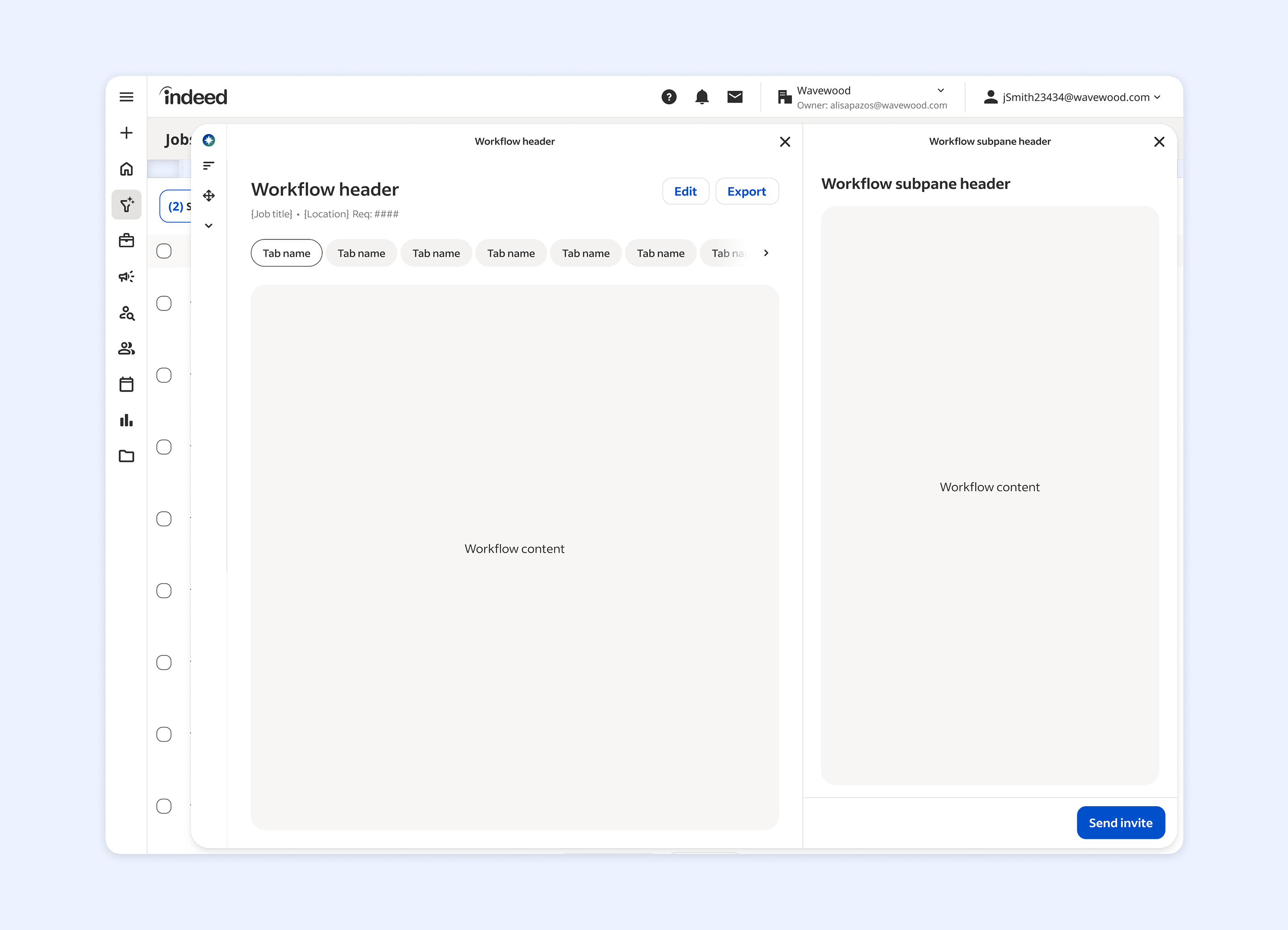
Subpanels
Workflow panes can trigger sub-panes for focused actions that benefit from side-by-side context. This became the framework for candidate lists, detail views, and messaging across Talent Scout.
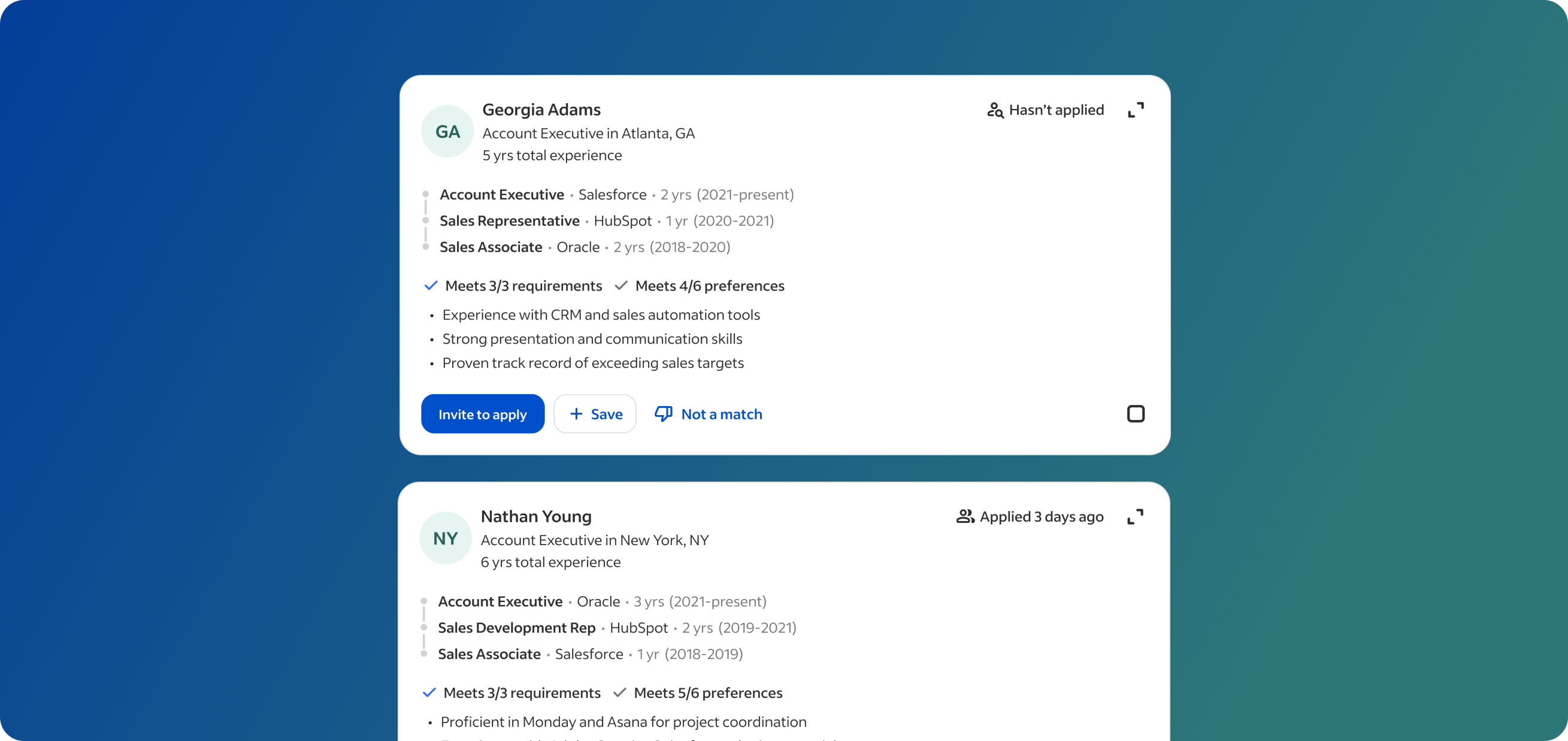
Redefining candidate cards with recruiter priorities
Drawing on 5+ years of recruiter research, I established a data hierarchy prioritizing location, experience, and match fit — the three things recruiters check before digging deeper. This pattern became the standard across employer products.
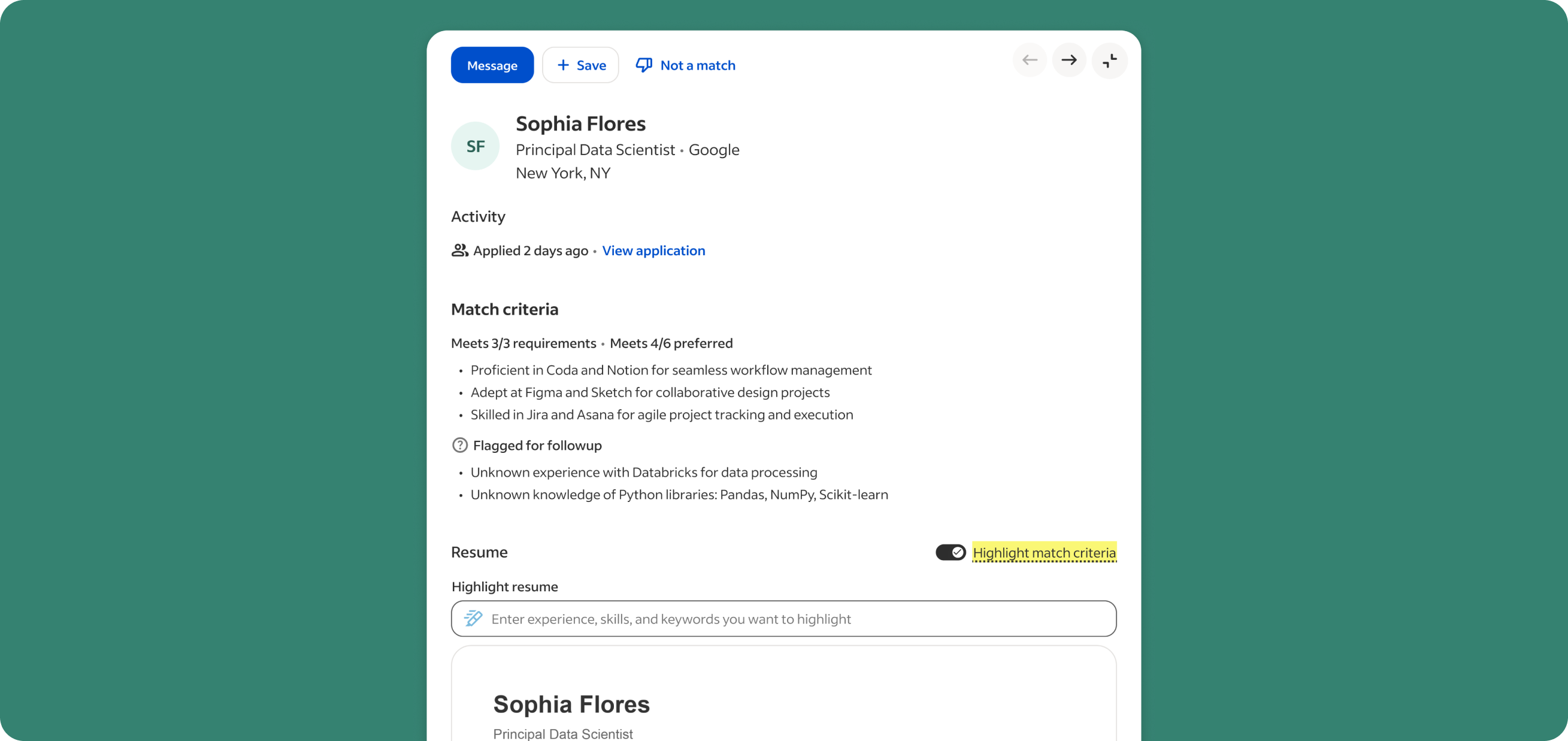
Progressive disclosure for candidate review
Recruiters needed both speed and context. So I designed cards that expanded inline to reveal activity, match data, and AI-generated reasoning—cutting review time while boosting confidence.
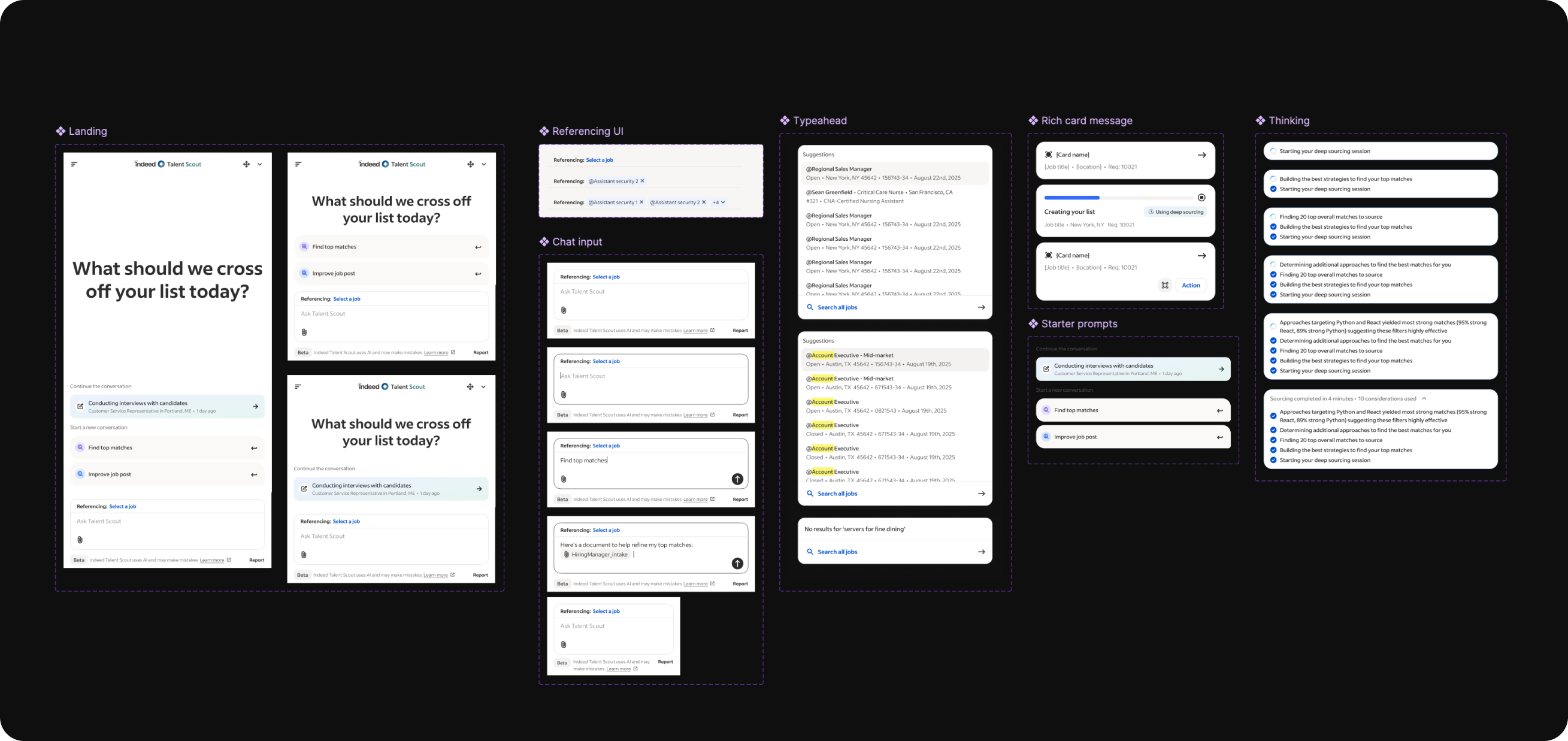
Candidate component library
As Talent Scout grew, we built a candidate component library with documented best practices. This let designers and engineers move faster without sacrificing consistency or quality — critical as we scaled across teams.
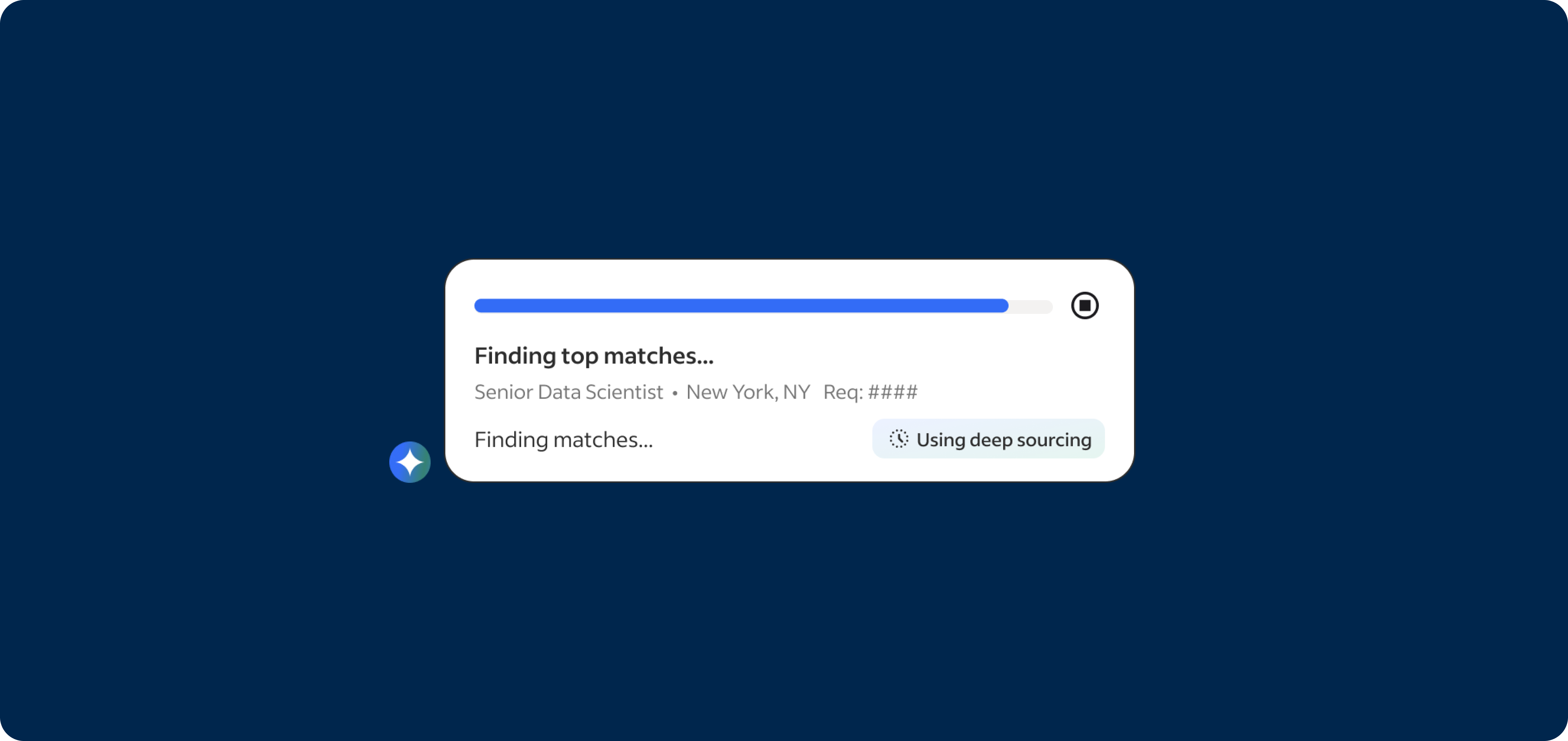
Introducing deep sourcing
The biggest unlock came when we asked: What if AI could search your entire talent pool simultaneously and explain why each candidate fit? That question became Deep Sourcing — an AI workflow that ran parallel searches across entire talent pools, then returned one ranked list with transparent fit explanations for every candidate.
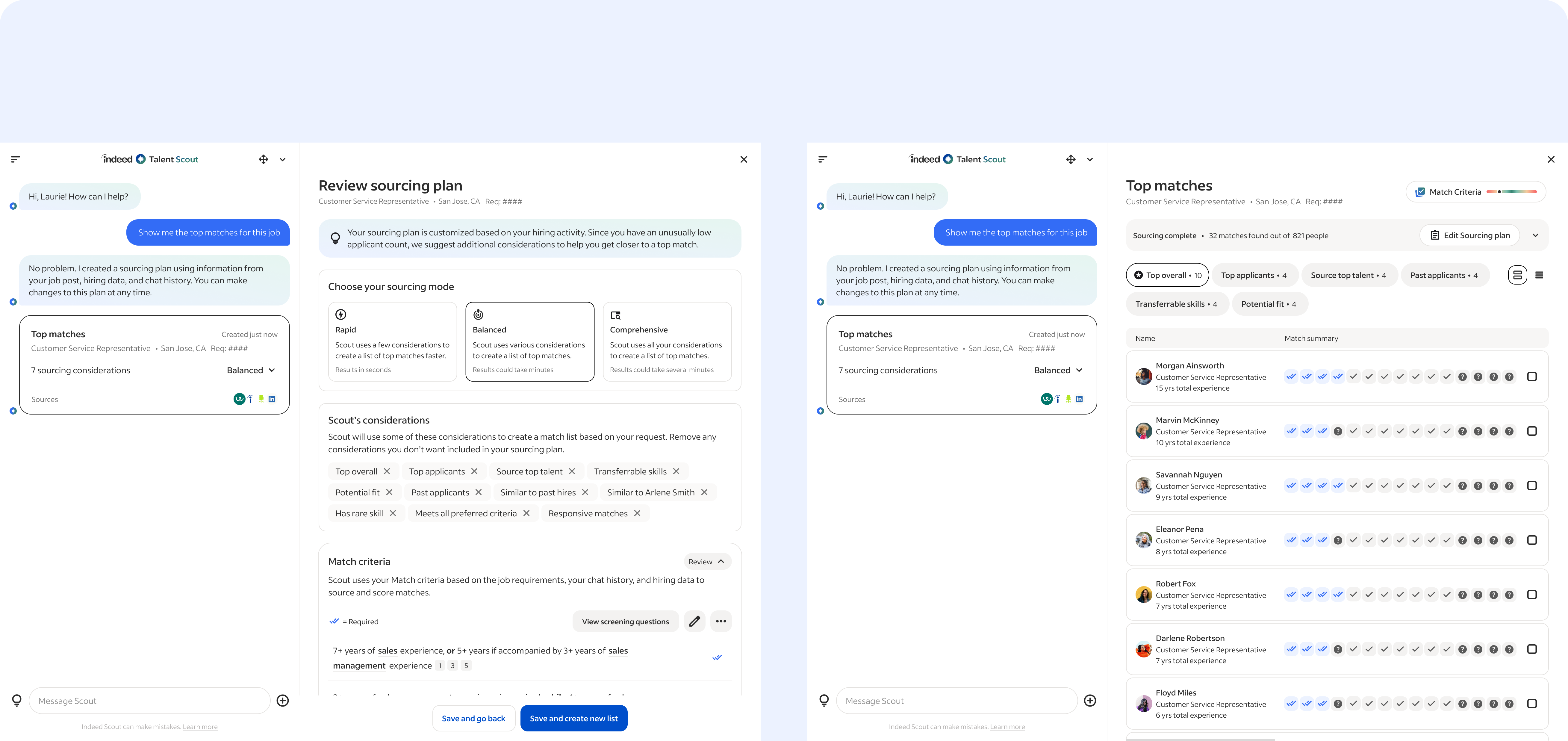
Deep Sourcing: From concept to system
Ideation
I co-led a week-long workshop with engineering to explore how Talent Scout's AI could transform candidate matching. We whiteboarded solutions, mapped technical constraints, and aligned on initial concepts to research.
My role as UX
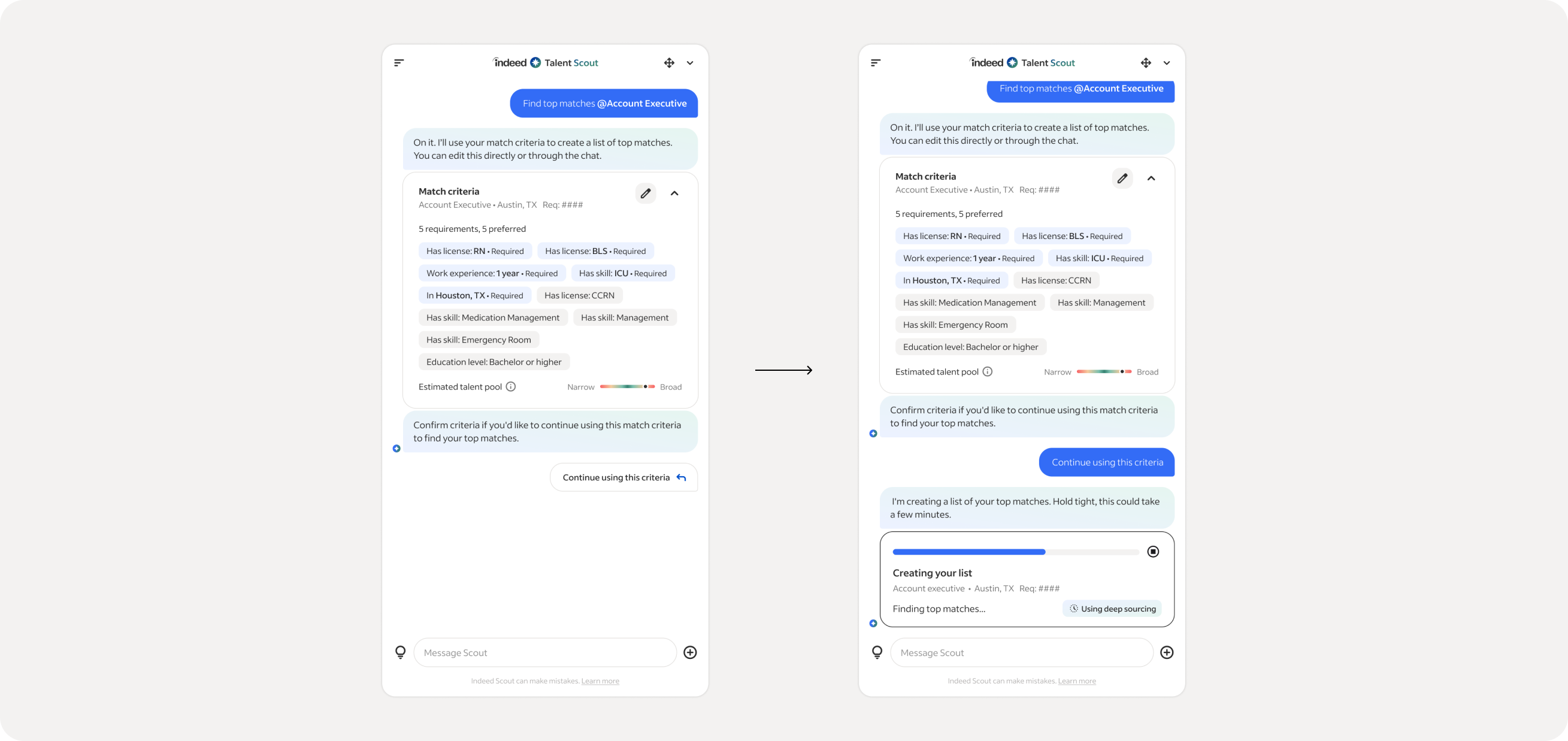
I translated early concepts into testable wireframes and interaction models, using design to drive conversations about feasibility, sequencing, and user value. These explorations made abstract AI capabilities concrete—and helped the team align on what to build first.
Research
User testing happened every two weeks. By week six, a pattern emerged: recruiters weren't asking for more features. They were asking for fewer steps. Two quotes captured what mattered:
“I just want to know the people that Talent Scout found.”
This insight drove a significant simplification: we auto-populated match criteria from job posts and reduced confirmation from multiple decision points to a single review screen.
“If I'm going to use you as the tool, I want to be able to use you to your fullest extent.”
We focused on delivering 10 excellent matches — not 100 mediocre ones.
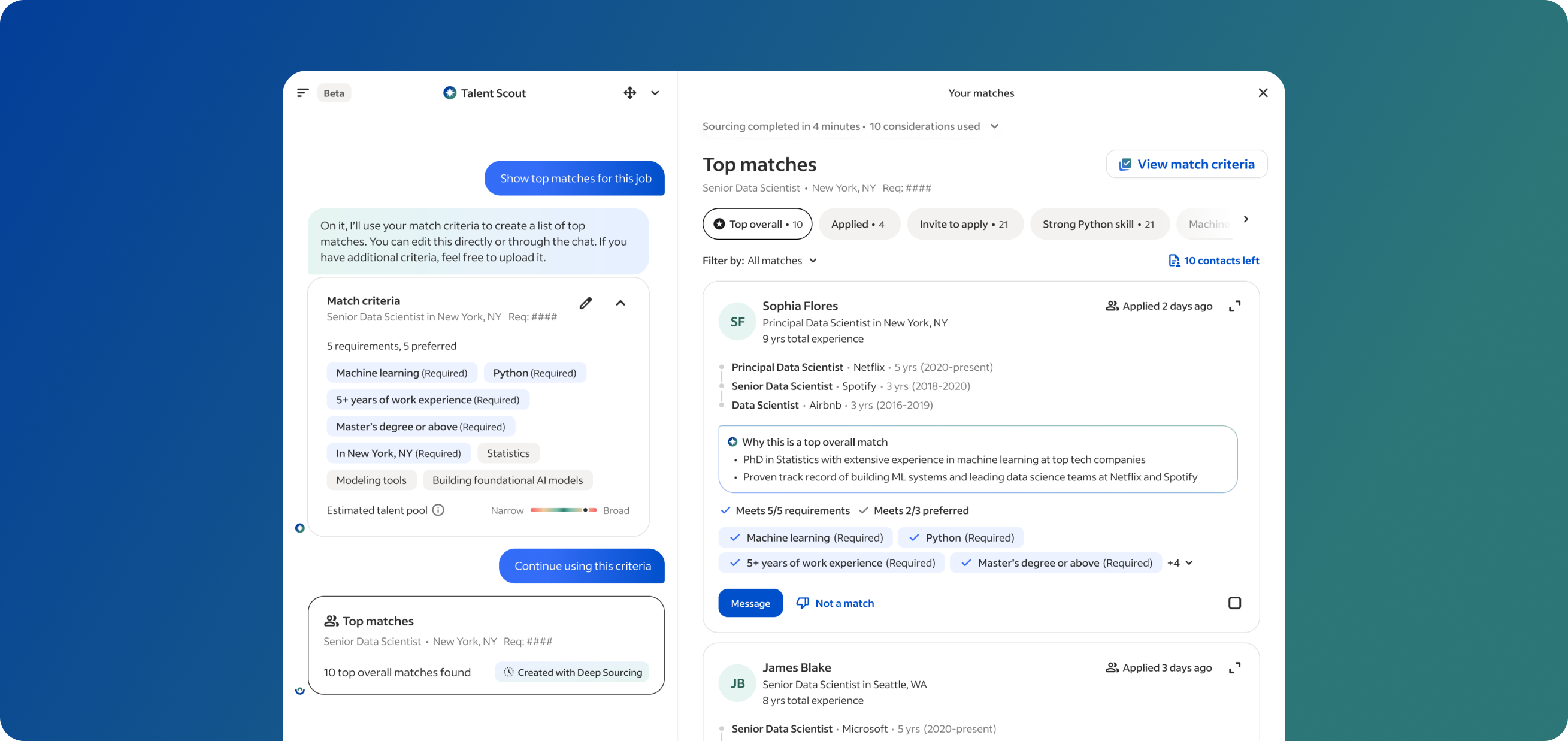
Launching Indeed's Deep Sourcing experience
We became Deep Sourcing as Talent Scout's AI-powered matching experience. It searches entire talent pools simultaneously, ranks results, and explains why each candidate fits — delivering both speed and confidence.
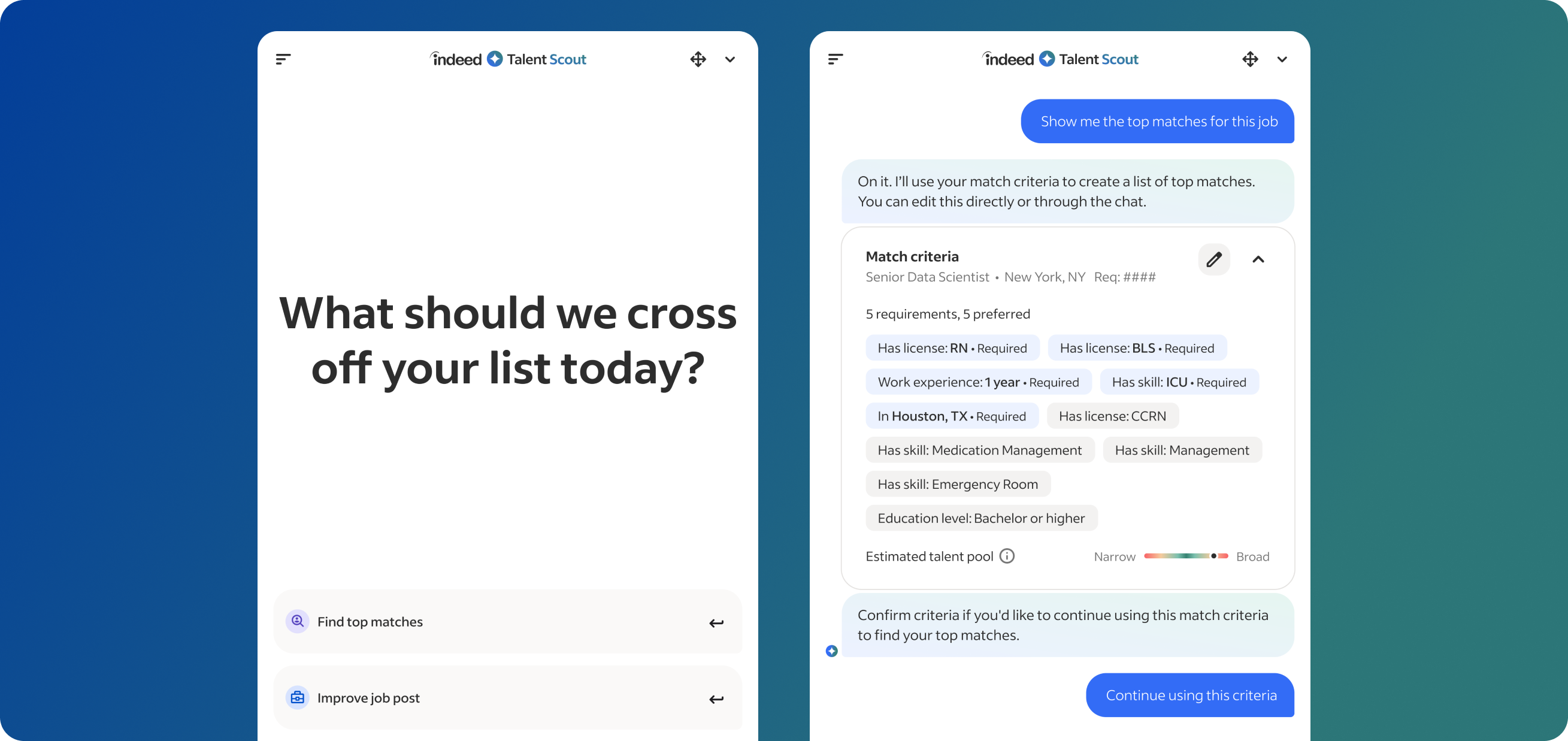
Match criteria for sourcing
Match criteria auto-populates from job posts, reducing setup friction and getting users to results faster.
This shift to 'results first' dramatically lowered the barrier to trying Deep Sourcing, while still optimizing results.
Making AI explainable
Research showed recruiters needed to understand why candidates matched, not just that they did. I designed comparative reasoning sections that synthesize resume details and job criteria into scannable fit explanations—building trust through transparency.
Redesigning outreach for AI-driven hiring
Great matches meant nothing if recruiters had to jump to another tool to act on them. I built the foundational UX for Talent Scout's outreach experience, keeping recruiters in one place. They could message candidates directly, personalize with AI assistance, and watch all activity sync to their ATS automatically.
Measuring success
Increased quality
Deep Sourcing delivered a 300% increase in high-quality matches and outperformed the current model with a significant increase in positive responses.
AI-fueled speed
We brought the product to market in 11 months. Within hours of launch, more than 100 employers joined the waitlist.
Strategic shift
Talent Scout became the foundation for Indeed’s future AI experiences, aligning multiple teams around a single, scalable sourcing platform.
Customer quotes
"That was riveting."
“Using Talent Scout will be like hiring two or three additional recruiters.”
"How quickly are we getting on the phone so that I can start to get my team trained in using this?"
Key metrics
28% retention rate
Week-over-week retention climbed to 28%
60% successful outcomes
60% of users successfully sourced candidates or completed recruiting workflows through natural language
68% match satisfactions
68% match satisfaction, up from 42% — a 26-point improvement over Indeed's baseline search

